




Welcome to the first episode in our Project Delta build series, where we pull back the curtain on our Royal Enfield Super Meteor 650 custom transformation. In this instalment, we’ll be walking you through the bike’s arrival, its stock form, and the first wave of big changes—tearing it down, laying out our plan of attack, and kicking off the all-important frame modifications. For us at Purpose Built Moto, these early steps set the tone for everything that follows.
Unboxing the Super Meteor 650: A Rare First Look
When a fresh bike turns up in a crate, it’s a special moment. Most of the time, we’re working on motorcycles that have lived a few lives already. But with the Super Meteor 650, Royal Enfield delivered it to us straight from the factory—still strapped down and unassembled in that big shipping box. It’s not a sight you get every day.
“Super Meteor turned up here in a crate,” Tom recalls. “Delivered earlier this year. First time we’ve been given the opportunity to unbox a bike, so we pulled it out, and it was actually one of my first times seeing the bike in the metal.”
From the jump, we knew we wanted to strip away a lot of the factory cruiser aesthetic. Right out of the box, the Super Meteor 650 sports a low seat, wide bars, and forward foot controls—hallmarks of a relaxed, long-haul cruiser. Its curb weight sits around 240 kg (529 lbs), with about 47 horsepower and 52 Nm of torque coming from the 648cc, 270-degree parallel twin engine. As stock cruisers go, it’s comfortable and approachable. But we had a completely different vision.
From Cruiser Comfort to Custom Classic
In standard trim, the Super Meteor 650 is built for laid-back touring. Royal Enfield introduced features like a larger fuel tank, revised geometry for relaxed ergonomics, and an easy-swinging suspension that soaks up bumps on longer trips. A real “hop on and ride” kind of machine.
- Engine: 648cc parallel twin (approx. 47 hp / 52 Nm)
- Weight: ~240 kg curb
- Chassis: A steel tubular frame with conventional forks up front and twin shocks at the rear
- Styling: Classic cruiser lines—low and lean
While it offers all-day comfort, we were itching to remove the bike’s excess and give it a genuine vintage feel—leaner, rawer, and more performance-oriented in a retro sense. The plan called for a big design pivot: adding a custom girder front end, shifting to a single monoshock at the rear, fabricating our own bodywork, and possibly rethinking the entire silhouette to highlight that lovely parallel twin.
Blending Heritage with Custom DNA
When Royal Enfield handed over the Super Meteor 650, their parting words were simple: “Call us when you’re done.” That level of creative freedom is exciting, but it also means we had to figure out exactly how to honour the brand’s heritage while injecting Purpose Built Moto’s DNA throughout the build.
From day one, we laid out a few key goals:
- Radically Reduce Weight: We wanted to create a “visceral ride experience”—where every twist of the throttle and flick of the bars connects the rider to the machine. The more we can strip away, the more pronounced that feeling becomes.
- Reinvigorate the Chassis: Instead of the stock twin-shock cruiser setup, we decided to build a monoshock arrangement at the rear. Up front, a custom girder fork would pay homage to older Royal Enfields like the Flying Flea, but with our own twist.
- Highlight the Engine: The 650 twin is a real gem. We planned a narrow, custom fuel tank and minimal side panels to let that blocky engine stand proud in the frame.
- Vintage Cues Everywhere: From the seat design and handlebars to potential modifications like a hand-shift setup, we aimed for an early-era aesthetic. But we also needed it to perform. We don’t build garage queens; we build riders.
Honoring Heritage, Building Without Limits
“Instead of relying on that personal relationship we usually have with a single client, we were relying on the history and brand image as a whole that Royal Enfield puts across.” – Tom
That meant drawing on the lineage of the Super Meteor (originally from the 1950s) and mixing in personal favourites like the Royal Enfield Flying Flea. Our plan? Borrow what made them iconic—girder forks, slender body lines, and minimal frills—and give it that modern flourish we’re known for at Purpose Built Moto.
Once the bike was freed from its crate, the next step was to remove everything that didn’t serve our new direction. We started stripping off stock plastics, the seat, fuel tank, exhaust system, and basically anything else that would get in the way of our extensive frame modifications.
“As custom builders, we’re not bound by the rules or regulations manufacturers have to abide by,” Tom explains. “We write our own rules when it comes to creating these motorcycles.”
Stripping It Down for a Clean Foundation
So out came the grinder and welder. Modern bikes are often over-engineered for multiple markets, meaning they have to meet a wide array of regulatory requirements. By removing items like passenger pegs, stock fenders, bulky lighting brackets, and extraneous plastic, we immediately dropped a good chunk of weight and opened up room for a complete redesign.
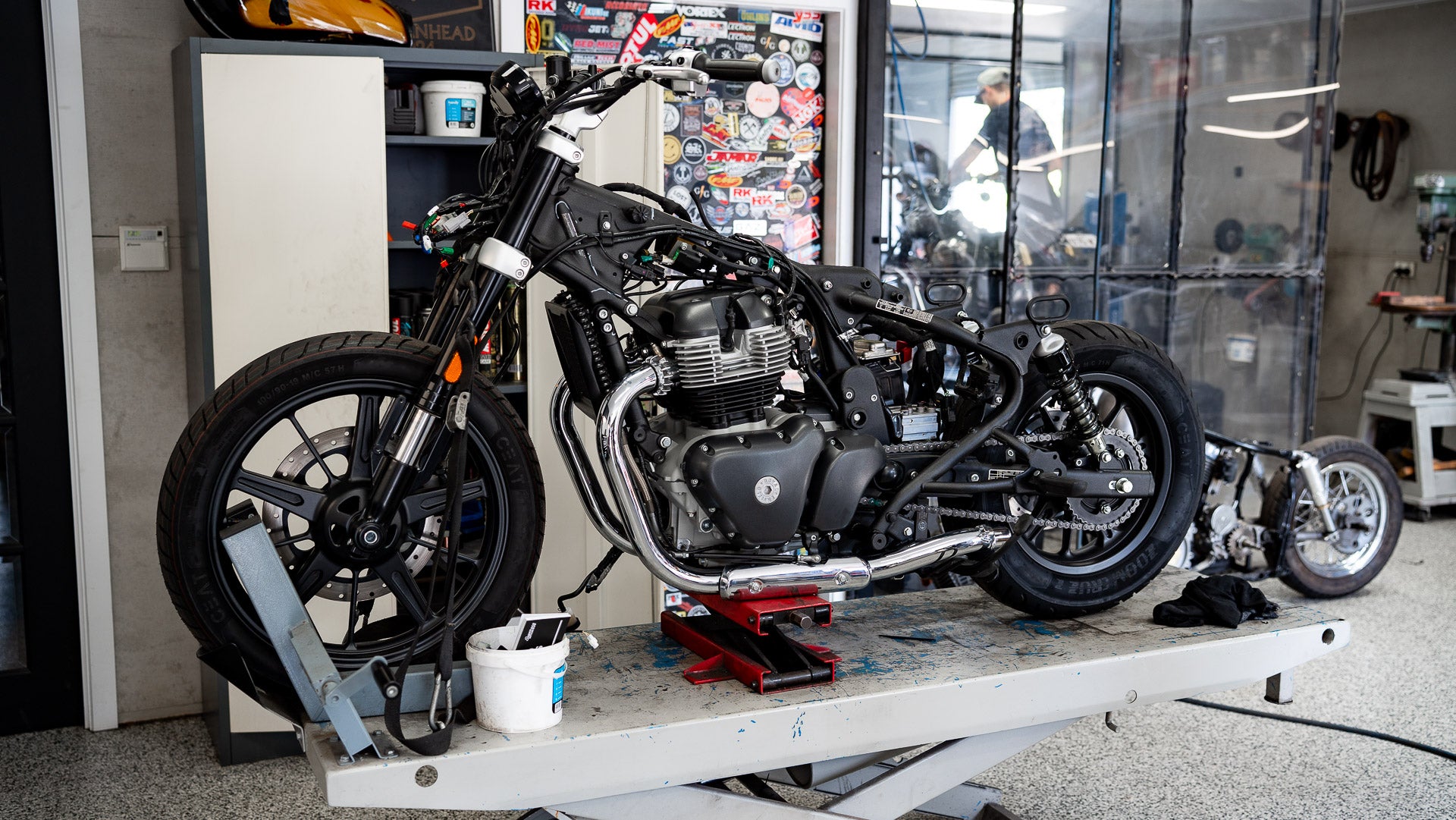


With the Super Meteor 650 laid bare, we had a clear view of the steel tubular frame. The factory design was set up to handle a low-slung seat height, plus the added weight of touring gear and a passenger. While perfect for a comfortable cruiser, that arrangement didn’t line up with our vision for something reminiscent of a 1950s Royal Enfield.
- Neck: We wanted to tidy up the bulky cast bracing around the headstock, replacing it with our own gussets that hint at vintage style.
- Backbone: Since we planned on a custom fuel tank, the stock backbone was too thick in areas. Slimming it down would allow a tighter, more streamlined tank design.
- Rear End: The standard twin shock mounts had to go. Our idea was a monoshock arrangement anchored near the engine’s main pivot point, eliminating the stock subframe loop and drastically altering the bike’s silhouette.
Designing a Clean, Classic Front End
Early on, we also discussed relocating the oil cooling system. Modern oil coolers weren’t common in the 1940s and ’50s, so we decided to incorporate an “oil in frame” concept. Sure, it’s less efficient than a modern radiator-style setup, but it would let us clear out the front of the bike and create a more open, vintage look. Every change we made was about stripping away visual clutter and emphasising the mechanical elements.
“When my grinder comes out, I do get a little excited,” Tom admits. “We have removed a lot of what was there just because, as we opened up the bike and stripped away the elements, I thought, ‘The simpler I can make this, the better it’s going to be.’”
One of the biggest decisions we made during the planning phase was to build a girder front end. Traditional to older Royal Enfields, girders have a raw mechanical beauty. They also bring a certain rider feedback you just can’t get with a modern telescopic fork.
Before we fired up the CNC and lathe, Tom jumped into a CAD program to nail down basic geometry—steering angle, rake, trail, and shock mounting points. With that sorted, the real fun began. We tested out shapes, studied historical photos of early Royal Enfield girders, and looked for a way to fuse that retro functionality with our own flair.
“We wanted to create a really classically styled front end, something that didn’t exactly mimic the Royal Enfield girder forks of old, but you could tell where they came from,” Tom says.
Crafting the Foundation for Project Delta
The plan also included an air shock to replace the old leaf spring or coil spring design used back in the day. This would let us tune the ride a bit more precisely—blending old-world charm with some modern adjustability.
At this point in the build, everything is wide open. The bike stands as a skeleton of its former self, with a bunch of fresh ideas pinned to the whiteboard. Wheels, tank, seat, swingarm, and that signature girder are all on the to-do list. Our next moves are critical. Once the welder and grinder come out to reshape the chassis, there’s no turning back.
But that’s exactly how we like it. This is where the art of custom building comes alive. From a distance, you’d just see a bike in a pile of parts. But in our mind, Project Delta is already starting to take shape. The big design questions—“What if we remove this? Should we relocate that?”—fuel the creative spark that ultimately turns metal and machinery into something more than the sum of its parts.
Episode 2: Building the Bones of Project Delta
In the next blog instalment, we’ll dive deeper into the frame’s new geometry, the finalising of that girder front end, and start bringing our sketches to life. You’ll see how the rear swingarm transforms to accommodate a monoshock, how we set up our wheels for that vintage look, and the early steps of seat design. At Purpose Built Moto, we thrive on pushing boundaries—and the next phase of Project Delta has plenty of that.
Stay tuned for Episode 2, where this stripped-down Super Meteor 650 starts taking form as a genuine custom creation. We’ll keep you updated on the highs, lows, and everything in between, giving you a front-row seat to our biggest project yet.
There’s nothing quite like tearing apart a brand-new bike to understand its true potential. With the Super Meteor 650’s factory trim behind us, the workshop is buzzing as we bring our vintage-inspired, performance-driven vision into reality. We hope you’ll keep following along in this series—because things are only just getting started.
If you have questions or want to know more about what’s happening behind the scenes, let us know. We’re always keen to share insights, and there are plenty of stories still to tell. Until the next episode, ride safe and stay inspired.

WE BUILD BIKES WITH PURPOSE.
Purpose Built Moto is home for unique custom motorcycle builds. We offer a unique motorcycle customizing experience in the heart of the Gold Coast.

Join our email list and receive exclusive updates.
Latest Stories ALL STORIES
-
14/09/2026
-
14/09/2026


